H12-811_V2.0実際試験、H12-811_V2.0試験ガイド、H12-811_V2.0練習試験
Wiki Article
君はほかのサイトや書籍もブラウズ するがもしれませんが、弊社の関連のH12-811_V2.0学習資料と比較してからCertShikenの商品の範囲が広くてまたネット上でダウンロードを発見してしまいました。CertShikenだけ全面と高品質の問題集があるのではCertShikenの専門家チームが彼らの長年のHuawei知識と豊富な経験で研究してしました。そして、CertShikenに多くのH12-811_V2.0受験生の歓迎されます。
Huawei H12-811_V2.0 認定試験の出題範囲:
| トピック | 出題範囲 |
|---|---|
| トピック 1 |
|
| トピック 2 |
|
| トピック 3 |
|
| トピック 4 |
|
| トピック 5 |
|
| トピック 6 |
|
| トピック 7 |
|
H12-811_V2.0模擬モード & H12-811_V2.0テスト問題集
HuaweiのH12-811_V2.0認定試験を除いて、最近非常に人気がある試験はまたHuawei、Cisco、IBM、SAPなどの様々な認定試験があります。しかし、もしH12-811_V2.0認証資格を取りたいなら、CertShikenのH12-811_V2.0問題集はあなたを願望を達成させることができます。試験の受験に自信を持たないので諦めることをしないでください。CertShikenの試験参考書を利用することを通して自分の目標を達成することができますから。H12-811_V2.0認証資格を入手してから、他のIT認定試験を受験することもできます。CertShikenの試験問題集を手にすると、どのような試験でも問題ではありません。
Huawei HCIA-Datacom V2.0 認定 H12-811_V2.0 試験問題 (Q11-Q16):
質問 # 11
In the figure, a web client sends an HTTP request to a web server, and the router in between performs operations on the HTTP request. Which of the following statements are false about the router's operations?
(Select all that apply)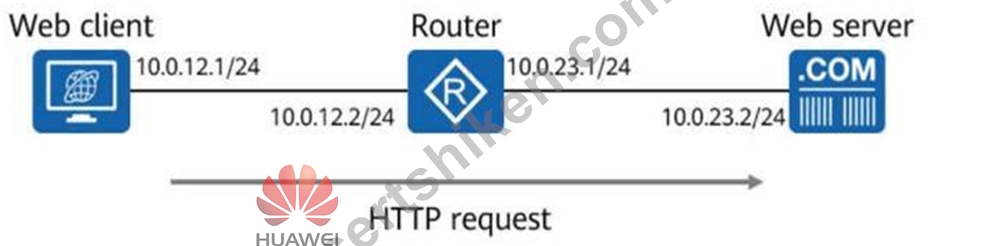
- A. The router removes the data frame header and checks the destination IP address.
- B. The router checks the content of the application-layer data and determines the port from which to send the data.
- C. The router encapsulates a new destination IP address before sending the data.
- D. The router searches the IP routing table based on the port number in the transport layer header.
正解:B、C、D
解説:
A router works mainly at the network layer . When it receives a frame, it removes the Layer 2 header and trailer, examines the destination IP address in the Layer 3 header, consults the routing table, selects the outgoing interface, and then re-encapsulates the packet into a new Layer 2 frame for the next hop. Therefore, statement B is true and is not part of the answer.
Statement A is false because the router does not create a new destination IP address during normal forwarding. The source and destination IP addresses remain unchanged end to end unless special functions such as NAT are used. Statement C is false because routing-table lookup is based on the destination IP address, not on TCP or UDP port numbers. Statement D is also false because normal IP routing does not inspect application-layer content to determine the outgoing interface. That decision is made from the network- layer destination address and the routing table. This question tests the layered forwarding logic of routers in TCP/IP networks.
質問 # 12
Which of the following phases are required for establishing a connection between an SSH server and an SSH client? (Select all that apply)
- A. Key exchange
- B. Version negotiation
- C. User authentication
- D. Algorithm negotiation
正解:A、B、C、D
解説:
The establishment of an SSH connection includes multiple mandatory phases that ensure both secure communication and authenticated access. First, the SSH client and server perform version negotiation to determine a mutually supported SSH protocol version. Then they carry out algorithm negotiation, during which they agree on the encryption algorithm, key exchange algorithm, integrity algorithm, and other security parameters to be used for the session.
After that, the peers perform key exchange, which is used to derive shared session keys securely over an insecure network. This stage is essential because it enables subsequent communication to be encrypted and protected against interception. Finally, once the secure channel has been established, user authentication is performed so that the server can verify the identity of the client user. This can be done using a password, public key, or other supported authentication method. Therefore, all four options are required phases in the SSH connection establishment process. HCIA-Datacom emphasizes these steps because SSH is a core secure management protocol used to replace insecure protocols such as Telnet and FTP in modern network operation and maintenance.
質問 # 13
IEEE 802.11 is the standard for WLANs. Which of the following 802.11 protocols uses 1024-QAM modulation?
- A. 802.11ac
- B. 802.11be
- C. 802.11ax
- D. 802.11n
正解:A
解説:
The correct answer is 802.11ac , so option C is correct. In standard WLAN evolution knowledge used in HCIA-Datacom, 802.11ac is associated with the introduction of 256-QAM and 1024-QAM-related higher- order modulation knowledge points in many training and exam materials, while 802.11ax and 802.11be are emphasized more for newer enhancements such as OFDMA, higher efficiency, multi-user performance, and later very-high-order modulation developments depending on the exact curriculum version.
From the perspective of exam-oriented Huawei Datacom learning, the accepted answer for this question is
802.11ac . Option A , 802.11n, is earlier-generation Wi-Fi and does not use 1024-QAM as the defining answer here. Option B , 802.11ax, is Wi-Fi 6 and introduces major efficiency improvements, but this question' s expected answer set identifies 802.11ac . Option D , 802.11be, corresponds to Wi-Fi 7 and is associated with even more advanced capabilities in newer standards. HCIA-Datacom WLAN questions often test the matching of a standard with one representative technical characteristic from the training materials rather than the entire modulation evolution history.
質問 # 14
DAD enables a node to detect whether an IPv6 address is already in use by another node before assigning it to an interface. This ensures that duplicate unicast addresses do not exist on a network. Which of the following packets are used for DAD? (Select all that apply)
- A. RS
- B. NA
- C. NS
- D. RA
正解:B、C
解説:
Duplicate Address Detection ( DAD ) is an IPv6 mechanism used to verify that a unicast address is not already in use before the address is assigned to an interface. DAD is implemented using Neighbor Solicitation (NS) and Neighbor Advertisement (NA) messages, which are part of the ICMPv6 Neighbor Discovery protocol. Therefore, options A and D are correct.
When a host wants to verify a tentative IPv6 address, it sends an NS message for that address. If another node on the link is already using that address, that node responds with an NA message, indicating the address is duplicated and cannot be assigned. If no NA is received within the required period, the host assumes the address is unique and can use it. Options B and C are incorrect because Router Solicitation (RS) and Router Advertisement (RA) are used for router discovery, prefix advertisement, and stateless address autoconfiguration, not for DAD itself. HCIA-Datacom emphasizes the distinction between Neighbor Discovery functions, including address resolution, next-hop reachability, router discovery, and duplicate address detection in IPv6 networks.
質問 # 15
Which of the following hosts are reachable to the host at 192.168.1.200/27 at Layer 2? (Select all that apply)
- A. 192.168.1.221/27
- B. 192.168.1.222/27
- C. 192.168.1.193/27
- D. 192.168.1.192/27
正解:A、B、C
解説:
A /27 subnet mask is 255.255.255.224, which means each subnet contains 32 IP addresses. The subnet increments in blocks of 32 in the last octet: 0, 32, 64, 96, 128, 160, 192, 224. The address 192.168.1.200/27 belongs to the subnet 192.168.1.192/27.
For this subnet, the network address is 192.168.1.192, the broadcast address is 192.168.1.223, and the valid host range is from 192.168.1.193 to 192.168.1.222. Therefore, 192.168.1.221/27, 192.168.1.193/27, and
192.168.1.222/27 are all valid host addresses in the same subnet and are reachable at Layer 2 without routing.
That makes A, C, and D correct.
Option B is not correct because 192.168.1.192/27 is the network address of the subnet and cannot be assigned to a host by default. This question checks IP subnetting and the ability to identify valid hosts within the same broadcast domain.
質問 # 16
......
お客様はH12-811_V2.0問題集に対して何か質問がありましたら、個人的に遠慮なくHuawei会社とご連絡します。私たちは是非あなたのH12-811_V2.0問題集についての質問に対して、真面目に回答します。私たちは最高のH12-811_V2.0問題集とサービスを提供し、できるだけお客様を満足させます。もちろん、多くのお客様は私たちを信頼します。
H12-811_V2.0模擬モード: https://www.certshiken.com/H12-811_V2.0-shiken.html
- 試験の準備方法-100%合格率H12-811_V2.0日本語受験教科書試験-最高のH12-811_V2.0模擬モード ???? ⮆ www.xhs1991.com ⮄で( H12-811_V2.0 )を検索し、無料でダウンロードしてくださいH12-811_V2.0テストトレーニング
- 信頼できるH12-811_V2.0日本語受験教科書 - 資格試験におけるリーダーオファー - 最新の更新H12-811_V2.0: HCIA-Datacom V2.0 ???? ➽ www.goshiken.com ????で▶ H12-811_V2.0 ◀を検索して、無料で簡単にダウンロードできますH12-811_V2.0的中関連問題
- H12-811_V2.0テキスト ???? H12-811_V2.0資格取得 ???? H12-811_V2.0テストトレーニング ???? 今すぐ➥ www.copyright.jp ????で➽ H12-811_V2.0 ????を検索して、無料でダウンロードしてくださいH12-811_V2.0テキスト
- H12-811_V2.0試験の準備方法 | 認定するH12-811_V2.0日本語受験教科書試験 | 実用的なHCIA-Datacom V2.0模擬モード ???? { www.goshiken.com }サイトで[ H12-811_V2.0 ]の最新問題が使えるH12-811_V2.0日本語版
- 試験の準備方法-100%合格率H12-811_V2.0日本語受験教科書試験-最高のH12-811_V2.0模擬モード ???? URL [ www.shikenpass.com ]をコピーして開き、▷ H12-811_V2.0 ◁を検索して無料でダウンロードしてくださいH12-811_V2.0受験トレーリング
- H12-811_V2.0試験合格攻略 ???? H12-811_V2.0認定テキスト ???? H12-811_V2.0日本語版トレーリング ???? ➽ www.goshiken.com ????で⏩ H12-811_V2.0 ⏪を検索して、無料で簡単にダウンロードできますH12-811_V2.0日本語版
- Huawei H12-811_V2.0 Exam | H12-811_V2.0日本語受験教科書 - あなたのH12-811_V2.0試験の合格的なプロバイダー ???? URL ⮆ www.topexam.jp ⮄をコピーして開き、➽ H12-811_V2.0 ????を検索して無料でダウンロードしてくださいH12-811_V2.0試験合格攻略
- H12-811_V2.0専門知識内容 ???? H12-811_V2.0学習資料 ???? H12-811_V2.0学習資料 ???? 最新▷ H12-811_V2.0 ◁問題集ファイルは“ www.goshiken.com ”にて検索H12-811_V2.0資格取得
- H12-811_V2.0試験問題 ⤴ H12-811_V2.0試験合格攻略 ???? H12-811_V2.0認定テキスト ???? ⏩ www.shikenpass.com ⏪で➥ H12-811_V2.0 ????を検索し、無料でダウンロードしてくださいH12-811_V2.0難易度
- 試験の準備方法-更新するH12-811_V2.0日本語受験教科書試験-ハイパスレートのH12-811_V2.0模擬モード ???? [ www.goshiken.com ]には無料の➤ H12-811_V2.0 ⮘問題集がありますH12-811_V2.0日本語版対応参考書
- H12-811_V2.0日本語版対応参考書 ⏳ H12-811_V2.0日本語版 ???? H12-811_V2.0難易度 ⏲ 今すぐ{ www.copyright.jp }で[ H12-811_V2.0 ]を検索して、無料でダウンロードしてくださいH12-811_V2.0ファンデーション
- notefolio.net, elijahjxxc239895.wikiconversation.com, tinybookmarks.com, miriamfupo158203.blog-eye.com, www.stes.tyc.edu.tw, carawcgs108612.vigilwiki.com, www.stes.tyc.edu.tw, janicedkrk157118.bloggazzo.com, www.stes.tyc.edu.tw, margiebmwy763855.anchor-blog.com, Disposable vapes